


On the evening we first landed in the United States in 1990, a month after our wedding, Vesna and I ended up in a moldy basement in Chicago. Our new country, our new home, our new life, in a room that smelled of damp and time. The people we met, however, were more than merely new.
Upstairs, on the first floor, lived deda (means grandpa) Nikola and his wife, baba (means grandma) Marija. For forty years they had swept the floor at a downtown bank on the night shift, the very same job they got after immigrating. Same bank, same floor, same shift, for forty years.
The basement was theirs. “You can stay with us,” they said, “as long as you need.” We were their guests, and we paid nothing. Everything in that basement actually worked: the water, the electricity, the phone. (How that ended in twenty dollars a month is a story I told in Self-Made.)
The morning, and every morning after that, started with twenty minutes of Nikola’s asthmatic coughing, from above our bedroom. Each time it sounded like the end of Nikola. Twice we had to rush him to the emergency room at night, because no spray could open his lungs enough.
My European structural engineering credentials would take years to certify. I spent months scraping the walls of burnt-down homes and taking care of a man who was quadriplegic. From inside those basement walls, the new world of American society was distant and surprisingly inhumane.
But inside those walls, there was grandpa Nikola, who welcomed me into the new world and took time to help me understand how it works.
Orphaned at four, he passed from foster home to foster home, some of them cruel enough that he had to run away, again and again. I still try to picture him as a small boy, running from one bad house to the next. Selling combs door to door in Germany, until a Nazi officer opened the door and shipped him to Dachau. Then forty stern years of nights on a bank floor. He never complained, and always loved. People, life, skies.
There was no mindfulness training in his life. No storytelling workshops. No self-help books. Yet I have never met anyone with more presence, wisdom, and a bigger heart than mystic Nikola. With him, every day was a sacrament.
For forty years, people in swank suits walked across the floor Nikola and Marija swept in the night. Not one of them, I would bet, knew whose floor they were walking on.
It took us a couple of years to find out we were not the first.
Before us, there had been eleven others. With me, that made twelve people Nikola and Marija had taken into that basement and carried through their most difficult times. The eleven came from the United States, Croatia, Serbia, England, and France. They ended up with their own degrees, careers, or teaching positions around the world.
Nikola and Marija never mentioned any of them. I found out about the first one by chance, from another of the twelve who had married the daughter of the leader of a global organization. We were never in the same room, but we kept bumping into each other because everything good is somehow connected. We jokingly called ourselves the twelve disciples.
Twice I met immigrants who had made it big. A lot of money. Big homes with twelve rooms, and nobody in them. They were building little empires for themselves. I heard them ask deda Nikola, “Why are all these people drawn to you?”
He would not answer, or say “I don’t know” if he had to say something. Then he turned his attention to something or someone he was wondering about in this enchanting world.
Twelve rooms with nobody in them. One moldy basement with twelve lives in it.
Hold on to Nikola. We will come back to him.
THE ANCIENT KICKER
By some accounts, the world should have ended a long time ago.
In the Talmud, Rabbi Abaye says the world holds at least thirty-six righteous people. He finds the number in one small Hebrew word, built from the letters lamed and vav. Thirty and six. The storytellers carried the number out of the study hall and into the villages of Eastern Europe, and the thirty-six became “the hidden ones.” In Yiddish, the Lamedvovniks.
As the story came to be told, God has seen the cruelty, the wars, the long ledger of suffering, and is ready to close the book and end it all. Each time, God sees thirty-six people so good that he cannot bring himself to do it. For their sake, the book stays open, and the world goes on.
And here is the ancient kicker. Nobody knows who the thirty-six are. Mechanics, farmers, dancers, politicians, actors. Someone who sweeps a bank floor at night. Or the bank’s president herself. They don’t know it either.
The people who give us hope live where the world has forgotten to look.
We can draw from the Jewish mystics, as we draw from any wisdom tradition, as grateful guests. The legend speaks to our ability to see beauty in all people, and it feeds our faith in the world.
TIMES SQUARE SCREENS
I, and most New Yorkers, don’t go to Times Square when we don’t have to. Too many neon lights is not the issue.
It is too many stories. A burned-over district of stories. Every surface of every wall is covered with a story that someone invested millions of dollars into telling, to sell us the gin, to sell you the pants, to sell me a book. There’s never enough oxygen in Times Square.
And we carry Times Square in our pockets now. The celebrity, the influencer, the show we stream at midnight. Grand stories crowd and push and insist, arriving from screens, algorithms, and institutions that have a stake in what you and I believe about ourselves and the world. Funded, produced, and loud.
That is where most of us learn what a beautiful person looks like. From people who are paid to be looked at.
Thousands of hours spent consuming stories instead of discovering them. Our imaginations directed at lives we will never live, and don’t need or even want to live, instead of at the life right in front of us.
Meanwhile, the people holding up the world are sitting next to us on the train. Pressed against us, close enough that we can smell their clothes and feel their heartbreak.
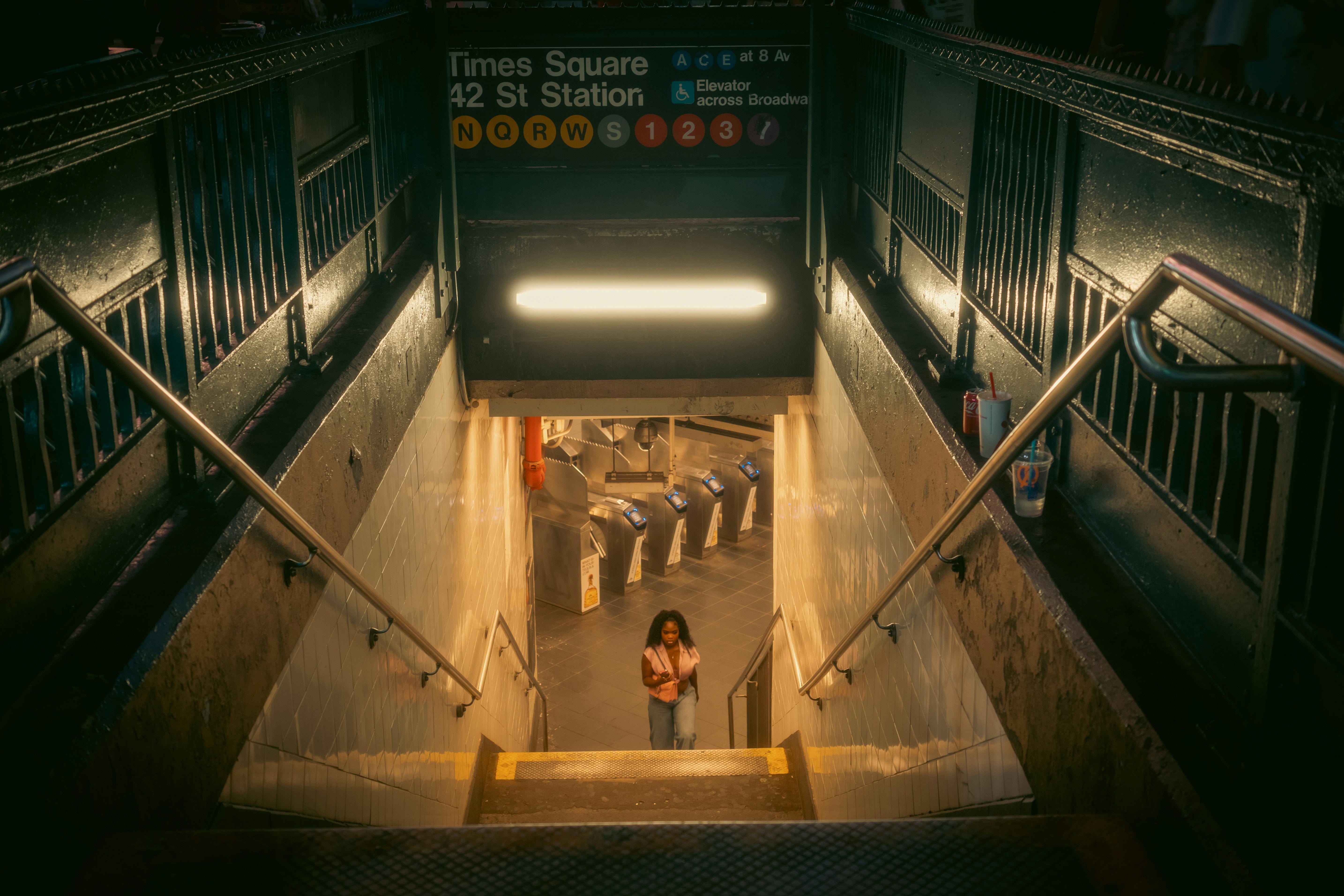
From the Christian tradition, there’s a line about the Word in the Gospel of John: “The Word became flesh. … And the world did not know him.” Religion tends to treat this as a tragedy. But there’s nothing wrong with not being known. I have come to read it as the most exhilarating sentence in the whole book.
The thirty-six are not hiding. It is just that we are looking at Times Square screens.
WE DON’T KNOW ENOUGH TO BE PESSIMISTS
Somewhere along the way, most of us concluded that choosing where to look, and how to see the world, is someone else’s business. Philosophers do that, artists, important people. Anyone, really, except us.
But we have been choosing the way we see the world our whole lives. Every time we decide what the slumped shoulders of the man across from us on the subway mean. Every time we decide what the immigrant woman selling M&Ms with her children asks of us when she meets our eyes. Every time we decide what the Wall Street guy’s frantic tap-tap-tapping on his phone is for. We already live inside our answer.
Our imagination changes the quality of our attention, and our attention is the power that changes people and the world.
We have built an entire culture around making fun of earnest people. Cool keeps us invulnerable. It commits to nothing. To believe in something visibly, to want something openly, to try something grand, that is cringe.
Cynicism is the one opinion we can hold about everything without ever being wrong, because it never bets on anyone.
I once told my daughter, crying over the state of the world: Love, we don’t know enough to be pessimists.
We don’t. Not about the planet, and not about the man across the aisle.
The goodness of the world is a daily decision. Not based on proof, not on goodness grabbing you by the collar and pinning you down to accept it. Rather, on a decision, available to you right now, in the face of your fears, frustrations, and specific small and large humiliations only you know about.
And no, the thirty-six are not saints. Actually, the saints were not saints. We all share in the muck of human life, and are invited to pay attention to its glory. Perfection belongs to God. Goodness belongs to us. And goodness has the word sorry in its vocabulary and dirt under its nails.
Attention is the penicillin for cynicism. Their stories are where we learn to pay it.
WHO KEEPS YOU FROM GIVING UP ON THE WORLD?
We want to sit with them and share what we find. Jordan Soliday and I are story guides. Through our nonprofit project Epic Ordinary 36, we will ask around, and we will ask you one question:
Who keeps you from giving up on the world?
Then we will go and sit with that person. We will listen, and we will write their story. With their permission, we will share it widely, through writers, partners, and the media, independent and traditional. In 2027, we will tell the first twelve. And we will help you do the same with your neighbors.
Twelve. I know where I learned that number.
THEY DON’T KNOW IT EITHER
Decades after that basement, I came to Chicago bringing my three-year-old daughter Ena to Nikola for his blessing. Gasping through his failing lungs, sitting weak on his bed, he took her into his lap.
She was not his blood. This was not his job. He put his hand on her head and passed on faith in us all.
Why are all these people drawn to you? I don’t know. He was not being modest. He did not know.
When you open your eyes to other people, something else happens, quite unexpectedly. You start to see yourself differently. You find out you have been guarding a surplus of love, not a lack of it.
Suppose we kept going past twelve. Suppose we had a thousand years and listened to every life on earth, the great artist’s mother and the woman at the bus stop and the boy who runs the register. We would reach the end of the world’s stories and still not know which thirty-six they were.
By then we would have seen the goodness in everyone.
Let’s pay attention to the people who keep the world alive.
Your neighbor may be one of them.
And so may you.
JOIN THE PROJECT
If someone came to mind as you read this, we’d love to hear their name. Reply and tell us who keeps you from giving up on the world. That is the heart of it, and it costs nothing.
If you’d like to help fund the work, we are raising $24,000 by December 31 to sit with the first twelve people and write their stories in 2027. The work has begun, and the first gifts are in. Give $100 to $5,000, or any amount. Your gift pays for the listening, the writing, the distribution, and the help to hundreds of others do the same. Epic Ordinary 36 is a fiscally sponsored project of Greater Things, a 501(c)(3) nonprofit, so your gift is tax-deductible.
When you give, you join the team, and we’ll stay in touch by email as the stories come in.
Give at epicordinary.org.
Twelve rooms with nobody in them. One moldy basement with twelve lives in it. That picture will follow me around for a while, on the bus and on the train, quietly asking who's sitting beside me. Thank you to Nikola and Marija!