


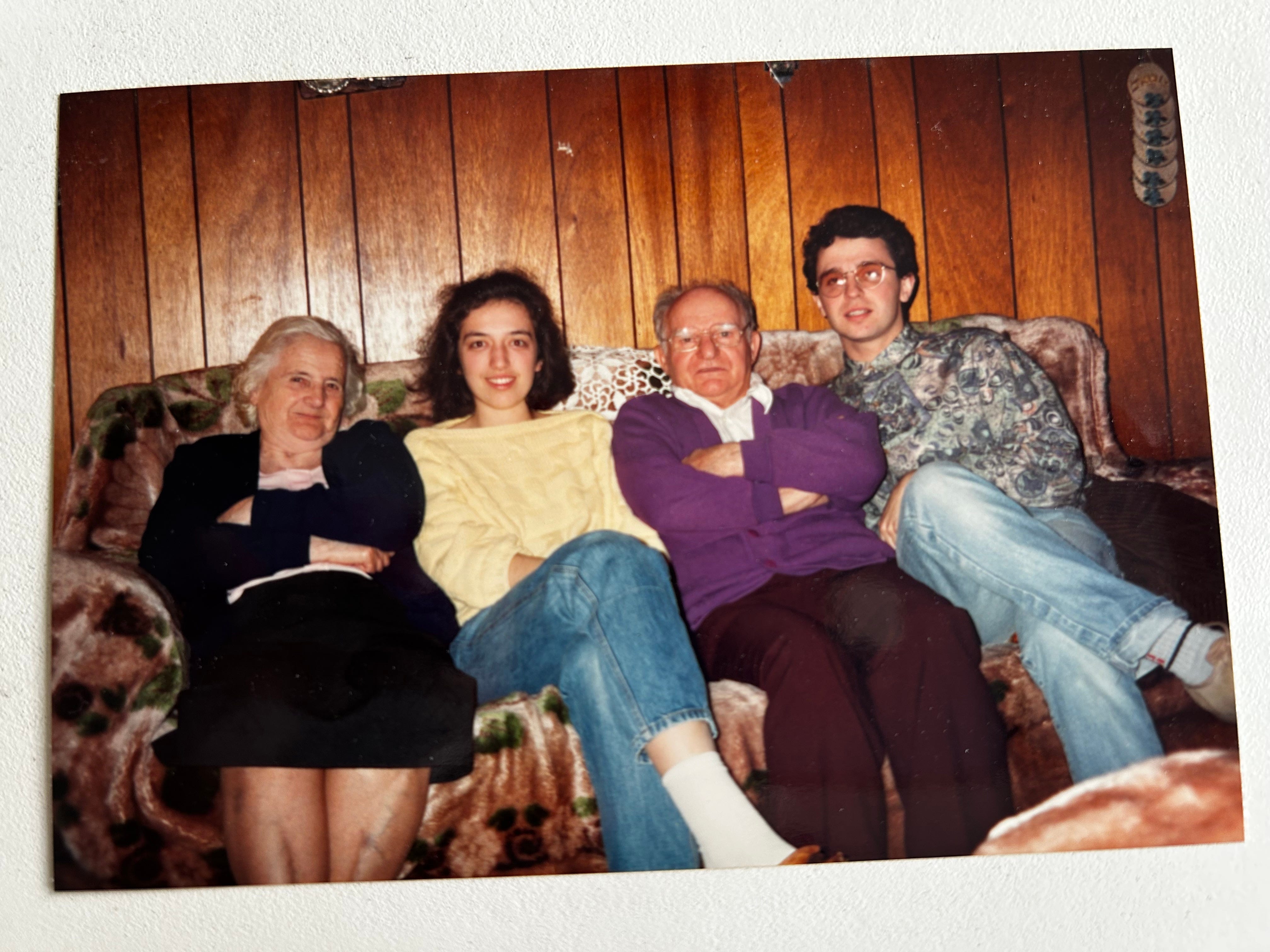
In my first year in America, Vesna and I landed in a moldy basement in Chicago. Deda Nikola and baba Marija lived above us and owned the place. We called them that from the very first day: deda is grandpa, baba is grandma. They had retired after forty years of sweeping the same floor at a downtown bank on the night shift, the very same job they got after immigrating.
Nikola grew up orphaned at four. He roamed the Balkans and ended up selling combs in Germany, door to door, until a Nazi officer opened the door and shipped him to Dachau.
“You can stay with us,” he said, “as long as you need.” Soon, we realized we had more money than Nikola and Marija. After six months of us insisting we wanted to pay, he said, “I see. Not paying makes you uncomfortable. Good then. From now on, you will have to pay every month. Twenty dollars.”
“But that doesn’t cover the phone bill, or electricity, or anything that goes into having us here,” we protested.
To which he replied, “Twenty dollars.”
There was no mindfulness training in his life. No storytelling workshops.
Still, I have never met anyone with more presence, more enchanting stories of ordinary life, more life intelligence and resilience, and a bigger heart than deda Nikola.
Once, when Vesna was away for a babysitting job, we stood in that basement kitchen in front of the oven, baking a cake he remembered from his childhood. We were so engrossed in each other that it never occurred to us to set a timer. An hour had passed, or two, or three, I don’t remember. At some point we wondered why there was so much smoke that we couldn’t see each other. The cake was incinerated, and I made another one right there and then. And we kept talking.
That run-down basement living could have gone wrong so fast and in so many ways, starting with the moment we arrived. But Vesna and I had committed not to even assess it. Over the years, I learned not to name what I am experiencing too early. Had I short-circuited the process, I would have short-circuited the story our lives have been drawn into. I could have made a judgment about the basement, the street, the city, the country, and the story would have stopped right there and then.
The truly new arrives without language. Something in us moves immediately to resolve the strangeness, to call the unnameable thing by an old name. To name the experience too early. To tell too obvious a story. The word closes around something that needed more time to become what it was going to be. The naming ends the ripening.
Years later, I wrote my doctoral dissertation on how our sense of meaning in life develops over a lifetime. I dedicated it to deda Nikola. He is the one person in my life I still suspect was an angelic apparition.
Long after that, here in New York City, Vesna and I were lying in bed thinking of him. A boy who ran from one cruel home to the next. Then a concentration camp. Then forty stern years of nights on a bank floor. And through it all, becoming the most joyful person we have ever met. Vesna asked, “How is that possible?”
Violent people and forces of history did not raise and make the man we came to know. Somebody else did. People whose names we don’t know, who owed him nothing and let him close, to see and taste their love. “They must have been there all along,” we concluded.
Nikola is one of a dozen stories I carry in my life. They are my string of pearls, and when life gets difficult, I clutch them. But there were more. And there will be more.
None of us is self-made, not even our own stories. Not the true ones, not the best ones.
👉🏽 Jordan Soliday and I host “Harvest Your Story,” where we help people find the story they most need to tell. And embody it in their relationships, professional contexts, and creative endeavors (like writing a book!).
The workshop is this coming Monday, October 19, at noon ET, and we have several spots left. You can apply for a seat here.