


There is a part of you that feels crazy.
Not diagnosably crazy. Just — off. Eccentric. Beyond the pale of what your strategic mind can sanction. It troubles you. It doesn’t fit the persona you have been creating. It is subversive to who you think you have to be in the world.
That’s the part I want to talk about.
I decided to become a pastor before I decided to become an engineer. The engineering came second, on purpose. A five-year slog in the school of engineering in Croatia, chosen deliberately, as a ticket into a graduate program in the United States where I could train for something entirely different. My crazy gave orders to my strategic mind.
That was thirty-odd years ago — one shape the crazy took. I'm not a pastor now. There have been several more since.
Back then I told my father about my adventure into faith. “I hear the music,” I said. He looked at me with a painful smile. Years later I said the same four words to Vesna’s parents, the day they sat me down to find out who their daughter was about to marry. The same painful smile.
Around that same time, Sonja — my first girlfriend and first kiss from middle school — watched me go through the ring of fire that becoming religious put me through. When I was down, beaten, about to give up, she told me: “Samir, there are some things worth standing for against the whole world.”
At that time, Vesna’s family and mine could not occupy the same room. We had two weddings. Two ceremonies. Two best men and maids of honor. Four roasted lambs, twice. Two sets of “I dos.” Each family pretending the other did not exist.
When we went to the airport to fly out to America, both families stood there together for the first time, to send us off. There is a photograph from that day. Vesna studies family photographs — where people stand, who’s touching whom, what their bodies are signaling — she says it tells you everything about the power moving through the relationships. In this one, both families are standing together, dumbfounded. Most of them are crying, or about to. Vesna and I are smiling, and neither of us could say why, except that we heard the music, and were ready to venture out.
The world is wild. Fierce, indifferent, larger than your agenda. And so are you. The wildness out there is symmetrical to something in each of us. You were not made for a tame world because you were not made to be tamed.
This wild part of us is the holy part of us. Forget that; they are the same. To be holy is to be wild!
That’s why you cannot name your crazy too early — the moment you name it, you have it under control, which means the wild is slipping away. You mostly encounter this crazy as a surprise — when someone sees it, they resonate, you resonate, as you feel the shock of being seen.
Some people say they believe in God. Some say they don’t believe in God. God says, “Who cares whether you believe in me or not? I don’t. I care whether you are paying attention and living alive.”
You have probably figured it out by now: You are not special. So get over it — but know that you are irreplaceable in your particularity.
You hear something we don’t hear. You imagine something we don’t imagine. You embody something we don’t embody. I am not giving you or me a compliment. It is a fact about your particularity; it means we are missing something without you.
If you have something to add to our conversation as humans — and you do — we need you to come out.
You owe us your crazy.
My patron saint David Bowie sings: turn your face to strange.
Including the strange in you. I know — you turn away from it because it feels like too much. I know — people gossip about your too-muchness. Turn your face to it anyway. Respect it. Offer it.
My Irish poet friend Mícheál Ó Súilleabháin wrote a poem called The Virtuoso about refusing to apologize for your own gift.
I don’t care if you’re sorry,
nor do you even, anymore.
Why atone for your gifts?
Express remorse for
your ability, begging
pardon in public?

Be instead, the
unrepentant virtuoso!
For you choose to stand
showing us the spirit stir,
then fill and overflow
within you.

The spirit does not
ask forgiveness,
nor permission.
And upon your stage
You can do no wrong.

Get out of the way,
we love what you have
and need no reminder
of our sentence here
on earth, please,
just set us free.
We don’t care if you are sorry.
We need you.
What is your virtuosity?
My friend Melissa Hefferlin, who is a professional painter, whose husband is a professional painter, and whose stepson is a professional painter, says everyone is an artist, and everyone deserves fans. Playfulness, she believes, is as profound as seriousness, and creativity is the defining gesture of being human.
We also receive wildness from a story larger than us. In my case, cooking found me before I found it — my parents were fanatics, and life gave me ten thousand kitchen hours before I was sixteen. I did not choose it. It chose me. But it was mine, my epic ordinary to keep.
Now. About cringe. Cringe is how we experience visibility. We would rather show up cool, because cool keeps us invulnerable. It commits to nothing. We have built an entire culture around making fun of earnest people. To believe in something, visibly, to want something, openly, to try something grand — that is cringe.
I often think, courage feels like fear. Equally, passion feels like cringe.
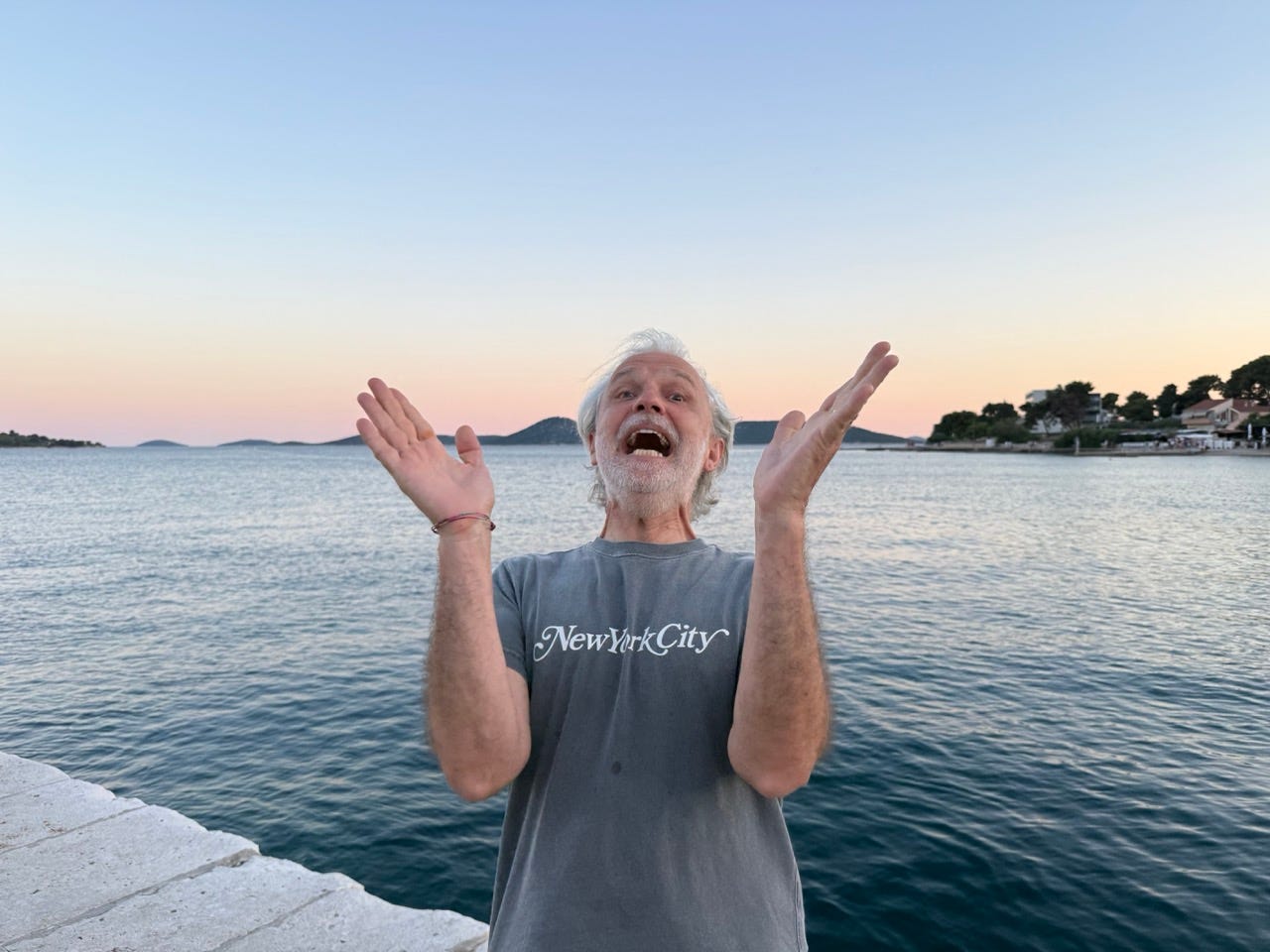
When I was a teenager in Zagreb, a few of us would cram into a beat-up car, smoking oregano (dealer convinced us otherwise) and dreaming of walking on the wild side in New York City. Ridiculous. Whoever does anything they see as significant has to outlive the embarrassment. You want what my friend Jordan calls a New Renaissance? It starts in mud, he says.
Get ready to be ridiculous to both yourself and others.
My friend Viji Sarah Boloico just did exactly this. Recently, she spent three days alone in total darkness — no phone, no clock, no light — a new single mother from a conservative religious background, and then she published all of it: the weeping on the floor, the old hymns she didn’t know she still knew, twerking on her yoga mat in the dark, and a vibrator she’d named Joey. She could have written the tasteful version. She wrote the true one instead. Viji is paying her cringe tax here, not to get your attention, but to take a risk of being herself.
My friend Rod manages fortunes for the wealthy and gives away nearly all of his own. Franciscan cross under the suit, sandals on littered asphalt far into the fall, a hug made of words for everyone who walks in. His crazy is a conviction he won't file down — that joy, kindness, and justice are the only sane response to life. He believes the world can be changed, and he lives as if it already is.
There was someone — maybe when you were young — who came to you and spoke in a way that cost them something. They paid attention to you, gave you time, and spoke in the epic language to your ordinary life. They told you what they saw in you. And you hid those words or that smile or that caring touch inside. They did not have to do that — say significant words — but they did. They paid their cringe tax to give you something you still carry inside. (I am 60 and my crazily kind friend Matt Stone still dares to do it for me.)
Now go be that person to someone else. That’s a good excuse to take these risks.
Go out of your way, find new words, dare to say to others, “I see you.”
The worst thing in the world is not to cringe. The worst thing in the world is to hide.
The best thing in the world is not to be successful. The best thing in the world is to see and be seen by the world.
So live alive. Be too much.
MORE
Reading about being seen is one thing. Here’s an hour of the real thing.
An Hour To Be Seen — we talk, and we write you a one-page story of this moment in your epic ordinary life at www.epicordinary.com.
A version of this piece becomes a chapter in my forthcoming book, SEEN: The Story of Your Epic Ordinary Life. Subscribe to The New Glossary, and I’ll keep you posted.