


We humans have learned to despair for a reason.
When what we love disappears, or when we believe we cannot love or be loved, or when we become aware of the outrageously short time we get to live on this planet, we enter a physiological and psychological winter. We give rest to the way we have understood and participated in the world. When there's nowhere to go, despair takes us in.
Last year, in Croatia, the sea was azure, the breeze was caressing, and in the evenings, the voices of people in the lively tourist town eating ice cream were swaying to the music of a street band covering Eurovision classics. One late evening, our daughter Leta walked into our vacation apartment, lay on the couch, and started crying. Inexplicably.
All that she had to say was that she knew too much.
She has spent the last seven years studying the environment and food systems of the world, engaging in social protests, serving those in need, and conversing late into the night with bright and passionate individuals from all over the planet. She loved the world, but she knew she was losing it.
The future was unsayable, and tears were all that was left. My wife, Vesna, our other daughter, Ena, her boyfriend, Samarth, and I surrounded and piled on her with our comforting weighted blanket of silence.
We need poets to help us with this sort of thing. David Whyte writes:
"Despair is a haven with its own temporary form of strange beauty and self-compassion; it is the invitation we accept when we want to remove ourselves from hurt. Despair is a last protection. To disappear through despair is to seek a temporary but necessary illusion, a place where we hope nothing can ever find us in the same way."
When we despair well, we let our bodies breathe fully and deeply. We come to know we will never be the same again.
Later in the night, I shared a story with her that offered both of us a thread we might be able to hold on to.
I heard that story from an anthropologist long ago and have used it and five follow-up questions as a tool in my consulting work with organizational leaders.
The New Tribe
Ten thousand years ago, a tribe lived in a circle around a fire, their source of heat and light.
Next to the fire were older people and children. Under the stars, the old would tell stories, and the young would dance.
Wood gatherers occupied the second ring around the fire. The tribe held wood gatherers and their never-ending task in great honor.
The outer ring of the tribe consisted of hunters and warriors admired for their strength and bravery.
One day, the wood gatherers said, "We should be the closest to the fire. If it weren't for us, there would be no fire." The tribe's council met, deliberated, and decided to do so.
Sometime after that, the hunters and warriors of the tribe said, "We should be the closest to the fire. If it weren't for us, there would be no tribe." The tribe's council met, deliberated, and decided to do so.
The elderly and the children were now in the outer circle. The fire's heat and light were there, but there were no stories of the old and dancing of the young.
This went on for a while.
One clear-sky summer night, an older woman stood up, walked through the crowd to the fire, took a piece of burning wood, and carried it outside the tribe's grounds.
She set the burning log down, sat beside it, and told a story. Then, the first child came.
The end.
Actually, the beginning.
--
My questions for leadership teams:
What sensory experiences and images in this story stir you, and why?
Write down memories of "stories" you have heard and "dances" you have experienced in your organization. Share them.
Who are the wood gatherers, hunters, and warriors in your organization? Write down the words of gratitude to them.
What would it be like to have an organization without stories and dancing?
What "stories and dances" are essential to your community?
Leta and I reminded ourselves that indigenous tribes worldwide would put older people and children in the center when they had to make an important decision. "Is the decision we are about to make going to protect and nourish our old and our young?" they would ask.
Then we wondered, "Can you imagine bringing the elderly and children in the middle of a congressional decision in D.C.? Can you imagine our politicians accommodating a throng of elderly talking and children dancing in the middle of a Senate floor?
Imagine them saying, "We cannot decide about our budgets, wars, or priorities if no children and elders are present! No voting today!"
We couldn't imagine it. To us, the present state of the U.S. tribe, as well as the global tribe, is incapable of meeting our shared challenges. Our global civilization has stepped off the cliff and is in freefall. Our hopes for the best will not prevent the collapse. All empires end, and this latest, being a global one, will be cataclysmic.
To gain clarity and know what to do with our lives, we realized we needed to accept not the possibility, not the probability, but the certainty of our current human tribe's decline.
All of our life, from our daily actions, words, and prayers to our public work of resisting, creating, fighting, and healing, to the work of scientists, artists, politicians, and business people among us, along with the work of every ordinary mystic matters in one way only: to make that older woman's trip for the burning log a possibility. What we imagined was the first annunciation of a new human tribe, one that will live by a different way of seeing and being in the world.
We wondered if it could happen in a hundred or a thousand years. We settled on ten thousand years as a realistic timeframe.
Today, this Friday in Harlem, this morning, this moment, as I edit this before sending it, all I'm doing is making an infinitesimally small act of support for that old woman and that child.
We are no longer fighting for our personal futures, our family's future, or the future of the U.S. or Croatia, any country, any party, any cause we can think of, or any change we can fathom. We do excellent professional work, tell stories, dance, do dishes, pay taxes, serve others, engage in politics, and get up early to witness a sunrise, we do it all for that old woman and that child ten thousand years from now.
I told her, "Zero in on them."
That helped her. That's something.
Despair, well-experienced, is like sitting inside a cave. Its darkness holding you and caring for you. All the while, invisible to us, the cave has a forest of hope and a sky of joy above it.
Let's sit in it as long as we need.
But no longer than we need. Because despair has its appointed time.
Whyte again:
"We take the first steps out of despair by taking on its full weight and coming fully to ground in our wish not to be here. We let our bodies, and we let our world breathe again. In that breathing, despair cannot do anything but change into something else, into some other season, as it was meant to do from the beginning."
Despair is hard, beautiful, and necessary. It is how we allow ourselves and each other to experience this difficult world and send our love for this world into the future.
What story can you tell, and what dance move can you make today? Tell it, make it, send your love into the future.
Samir
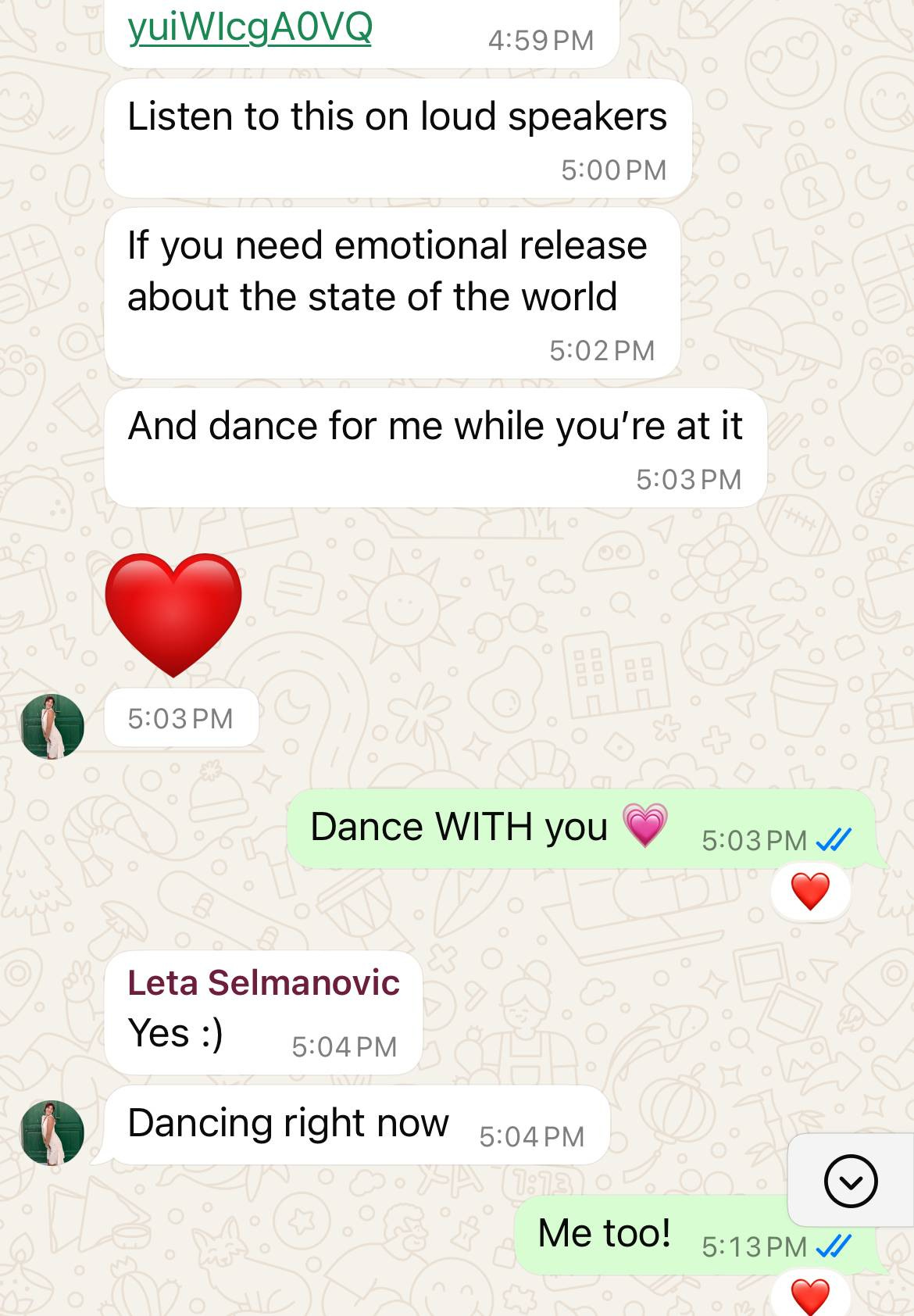
P.S. Months after this, my daughter WhatsApp-ed me a song (after the experience of milking cows with an old man in Italy and hearing his stories):
So much power imagery! Bringing the wisdom of th elderly and children to the center of our big decision making circles feel so right yet so far away. Not to romanticize despair but to feel the full weight of it is one way to arrive at clarity for the best next new steps.