


“This trip is not going to be easy for you, my dear,” said the lovely young woman who had raised Lucca as she looked me in the eye and placed the puppy in my arms. “This little one will challenge you beyond what you can bear.”
I was in Tillamook, Oregon, picking up an eight-week-old puppy named Lucca, and the trip was fifty years in the making. As a self-employed, screen-facing, wannabe writer, I needed the companionship of a sentient being. I remembered: when I was six, my dad brought a puppy home, and six months later, she was too much, and he took her away.
Now pushing sixty, I was six again.
Ahead of me was a two-hour evening ride to the airport, a six-hour flight, and two hours of local transportation to Harlem, New York City. I wasn’t worried. I had a lot of love to give. And a strategy. When she wails, I will be silent. When she stops wailing, I will talk to her.
I readied the car for her and hopped behind the wheel. Lucca directed her eyes at me from behind the mesh on the other side of the carrier screen. The wailing, honed by evolution to be unbearable, began. I waited until she stopped and started by introducing myself.
“Hi, pup. I am Samir, and I am human. As a result of millions of coincidences, you and I are here now, just the two of us. A two-species encounter in a black rented Kia. You’ve just lost your mom, dad, siblings, and a loving home here in this beautiful Cheese Country. Now, love, we are heading into the night.”
She was terrified, I could tell, and I was helpless.
While thinking of what to say next, she slipped back into the unbearable mode. The woman told me to consider her wailing a survival trick. It wasn’t a trick. Lucca was lost.
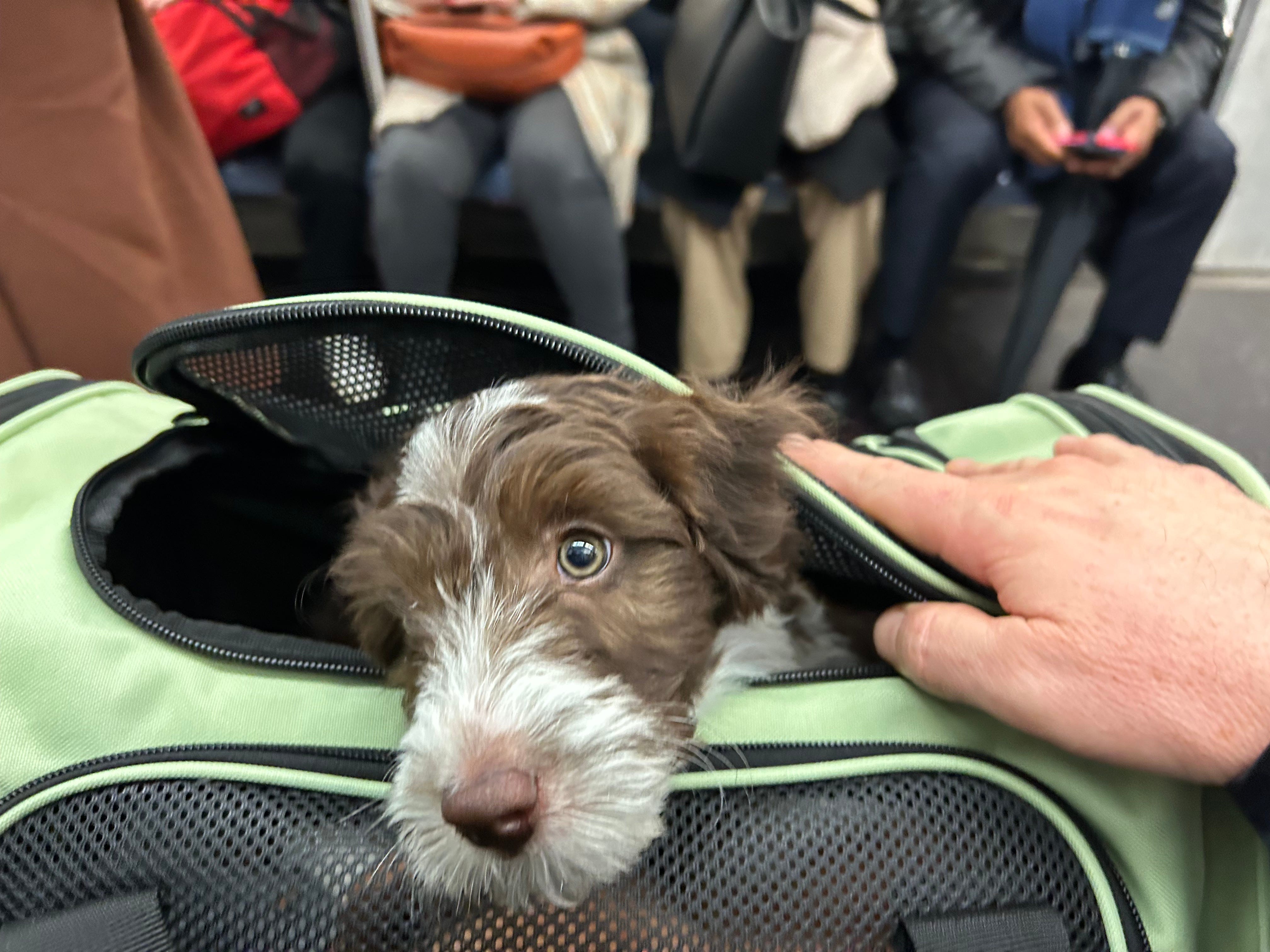
I told her about the new home awaiting her in Harlem. “It’s the most recognizable neighborhood name in the world!” I exclaimed. I described each room, each family member, and the streets awaiting her. When I stopped, she took it to another level with quieter, cuter, and far more unbearable sounds.
“I hear you, I really do,” I said, mirroring her voice. “You know, when I was six, my dad brought a puppy home to my eleven-year-old sister and me. We named her Lola, and it was one of the happiest days of my life. We did not know how to potty-train her or stop her from chewing my schoolbooks and my mom’s new white high-heeled shoes. My dad, without telling us, took her away. My sister stayed in her room for three days, my dad behaved as if the abduction didn’t happen, and my mom kept herself busy.”
This realization about my six-year-old self felt like the dark green night descending over us as we drove through Oregon. I became quiet. Lucca did, too.
Two creatures in a black rented Kia, heading into the night.
“Since I was six, a part of me has been sad and mad,” I told Lucca, “Until now. Now I have you. Would you have me?”
She stayed silent, and I took it as a yes.

At the end of the green night ride, Lucca and I got on the plane in Portland.
I had a problem. No matter how much I tried to cajole or coax her to go, she would not go. Hours were passing, and I thought that if I failed in making it happen, she was going to explode.
In the middle of the flight, I took her to the bathroom, spread a pee pad on the floor, and assumed a position with one leg planted at the door to prevent anyone from pushing it open and hurting the puppy, and the other planted behind the toilet.
When I lowered Lucca onto the pad, I was 100 percent sure that she would relieve herself on that damn pad.
She lowered herself onto the pad. And fell asleep.
After about thirty minutes of hovering over her like a drone, my leg muscles started twitching, and the flight attendant knocked. With my nose out the door, I described my predicament. People in line pitied me, and since there was another bathroom across the aisle, I was given a pass. But no business was done in our place. I tried the damn pad routine again at the Newark airport. To no avail.
A two-hour car ride, two hours at the airport, a six-hour flight, and one hour on the subway resulted in nothing.
Twelve hours after I picked her up, we came to our apartment, I took her out of the carrier, and while I was distracted with unfolding that damn, damn pad for her, she relieved herself on the wood floor, then the rug, then on the kitchen runner. This one-minute, three-stage shit show erased my idea of having an acceptable measure of control over a puppy.
Four weeks had passed. I didn’t sleep. I didn’t exercise. I met my work obligations, but only barely. I showered only when absolutely necessary. This was a standoff between the will of a grown man and the bladder, intestines, and teeth of a baby canine.
Further collateral damage came in the form of a stressed-out, late-for-work wife. She was completely exhausted just by watching me do this.
I looked out the window at the city streets and despised the dog owners prancing around with their perfectly tamed bags of shit. Why wouldn’t these neighbors have stopped me? Maybe put me in a kennel until my dream of having a puppy dissipated.
Four months into it meant four months of our lives lost forever chasing a barking, biting, chewing, diaperless devil’s own baby, destroying everything she senses to be precious to us.
I wanted to sleep, I wanted to stand under the hot water in the shower. I wanted to cook a meal. I wanted to get back to my work. I wanted to, in peace, think about the meaning of life. And maybe, if the cosmos would have mercy, be happy again.
Then one day, I was cooking, just cooking. I was taken away by my thoughts for the first time since Oregon when I spotted her in the middle of the room and was startled by a realization.
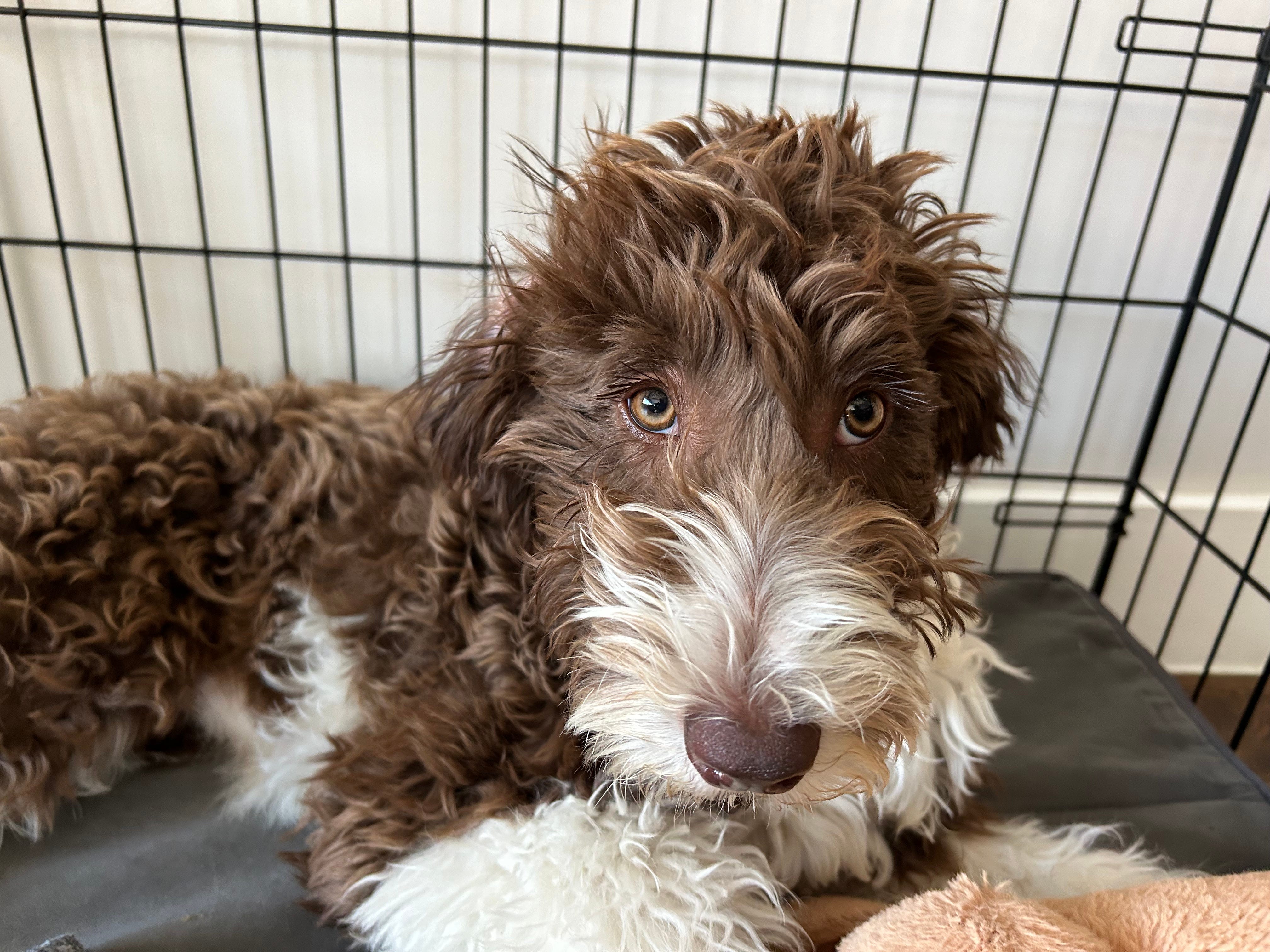
“Oh gosh. I am a dog owner.”
She was sitting with her butt on the ground, front legs straight, tall back, fully alert, with those eyes of hers—not beady, but rather with enough white in them that you can’t help but believe there’s a person in there.
I had forgotten I had her. One sliver of a moment, the first in four months, of not watching her.
She was now watching me.
She was watching me with a patient steadiness I had earned. And in that gaze, without a word, without even knowing she was doing it, she said:
“I see your effort. I see how these months have cost you. And I am telling you: I am worth it. I come to you with a gift you do not yet understand. But you will.”
I went back to cooking.
She kept watching me for so long; her gaze became the gaze of life itself. The steadiness of her eye contact told me we are not talking about the costly months here, but years, decades, all the way to the beginning. Life said to me:
“I see your effort. I see every story you’ve told yourself. Every year you’ve spent becoming who you thought you needed to be. Every drop of sweat or blood, every scream and silence, every year of love and loss. I see it all. And I am telling you: I am worth it. Every bit. You don’t understand it all yet–but you will.”
On her first birthday, I calculated that she had taken me out for 1,000 walks I would not otherwise have taken. A million steps I would not otherwise have made. I am a self-employed, screen-facing, home-office man with excellent reasons to stay inside.
She gave me the street.
And the window.
We live on the third floor of a building on Frederick Douglass Boulevard in Harlem, with one wall entirely made of glass. From up here, you are part of street life without the city staring in or you staring out. It is the best place in the apartment.
Half Border Collie, she sits in front of that window like an old shepherd dog on an Irish hill. Frederick Douglass Boulevard in Harlem is her valley, her domain, her responsibility. Every hour of the day brings something different, scurrying adults, children horsing around, yellow taxis, slow buses, the morning crowd, and the night crowd, all of them hers to watch over.
From up here, I began to notice the oak tree I had never seen before. It grew so big so fast. I began to see the people I had never paid attention to before. Working alone from home for years, I had given in to a quiet, private illusion: that I was essentially alone in the world.
Lucca took it away without an argument.
She just sat at the window. And the world was there.
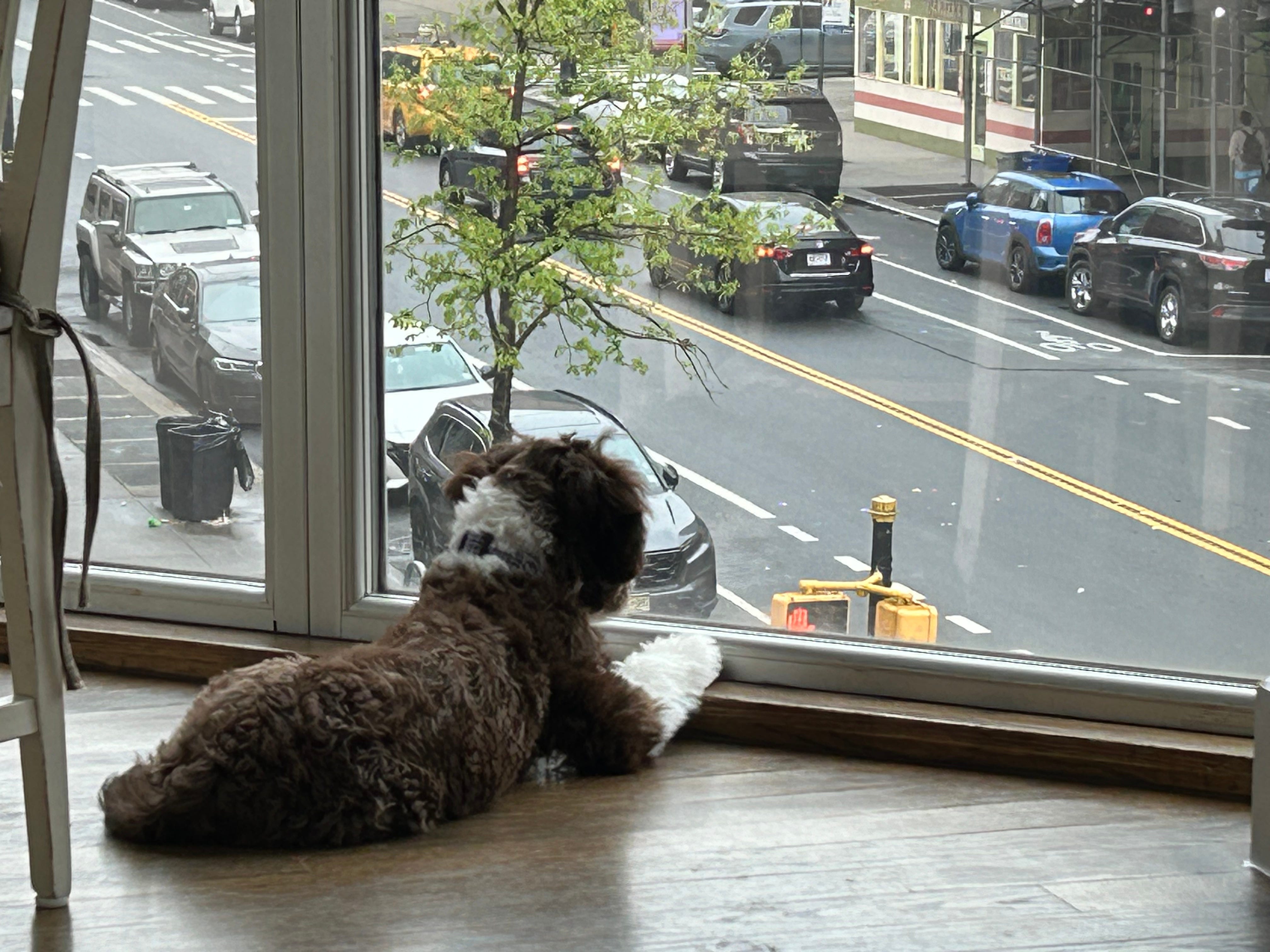
She became a portal. Not into a philosophy or a revelation, but into the actual world, the one that had been outside my window the whole time. And in the subway, and in the tired, crowded veterinarian waiting room in the Lower East Side.
She didn’t change my mind. She changed my radius. And inside that radius, I could see I was never, actually, alone.
I spent thirty years helping other people wake up. And now this.
I trained her with discipline. I disciplined myself to do it.
Sit. Down. Come. Stay. Four sessions each day, patient and consistent, everything the books told me to be. She didn’t understand what any of this choreography was for. But she knew I was engaged and that was enough for her. She was happy just to participate, happy to make me happy.
Though on the fourth sit, sometimes, she would look at me with those person-eyes and I could see the question forming, “Is this really necessary? Are you genuinely asking me to sit again, or are you now just asserting your power over a creature who loves you?”
Still. She sat.
I have spent years reading and thinking about transformation–how people change, what actually moves along our journeys of becoming. One night during those four months, I wrote a note to myself: if it were possible to open our skulls and use pliers to rewire ourselves into who we want to be, it would be a way inferior method of changing ourselves than having a puppy in your lap every day.
And then I hit her.
I lost patience. I was exhausted and frustrated, and I hit her. Once. And she looked at me with complete bewilderment in her eyes — not anger, not withdrawal, not fear. Bewilderment. As if she simply could not locate the logic of what had just happened.
I looked at my hand in horror.
How can I be capable of this? What gives me the right?
I have been learning about shame. Grappling with whether it can be something useful, something life-giving, something that protects rather than destroys. In that moment, looking at my hand, I had my answer. Shame arrived not to punish me but to help me. To say: this is not who you are. This is not how this works.
Because here is what I know about training a puppy: punishment takes you nowhere. Shame, yes, the shame that makes you look at your hand. But punishment? No. Only kindness moves anything. Only communication, only gentleness, leads anywhere real.
A dog doesn’t carry the verdict of every failure into the next moment. A dog does not need to earn its place in the room.
Lucca trembles with delight. She quivers in her readiness to do everything she possibly can. She stands in one place and waits, and waits, and waits.
And asks a question I could not unhear:
“What would happen if you treat yourself like you treat a puppy?”
Not as sentiment. As a method. The same presence, the same return to the moment, the same gentleness after every mistake I make. What would it be like to say sorry to yourself, to forgive yourself, to respect and delight in yourself like you respect and delight in me? How about that, Mr. Transformation?
I should tell you about my wife.
She was bitten by a dog once — a chained, frightened animal outside a store, a crowd pushing it towards her. She agreed to Lucca the way you agree to something you have researched and accepted, but do not yet believe. “The studies are clear,” she said, “Dogs are good for your heart, good for your mental health, and good for your longevity. Fine. You can have your dog.”
Lucca’s greatest happiness, it turned out, is my wife’s arrival home.
In the morning, when Lucca has not seen us all night, she bypasses me entirely and leans into my wife. I have trained her, cleaned her, medicated her eyes, and done every undignified thing a dog owner must do. And still. She goes to her.
I don’t know what to make of this. I have decided not to.
Now let me tell you about the city.
I think about what would happen if, by some rapture, every dog in New York City disappeared overnight. I have come to believe the city would not survive it. Not the buildings — but the people. The mental health would collapse. The loneliness would become unbearable. The physical health, the order of daily life, the ten thousand tiny blessings people get when they leave their apartments and nod at strangers — gone.
In a city of asphalt and screens, dogs are our contact with the wild. There is still a wolf in them. A wolf who chose to adapt, to change, to come inside and learn our strange human ways and live in our cement buildings and walk beside us on our leashes.
That wolf looked at us and said: I am all in with you, my human.
There is a verse in Ecclesiastes — the book of Solomon, supposedly the wisest king ever — in which he grapples with how little we humans actually know. We are so deeply in the unknown, he says, so surrounded by uncertainty, that everything we live is essentially a hunch. A conjecture. A beautiful, vain, and desperate guess.
To illustrate this, at one point he says, “We humans do not even know whether dogs will inherit eternal life.” Whether they will go on and live forever.
The wisest king. And this is what kept him up at night.
I have been thinking about this.
What if this whole planet is not about us? What if the entire story — all of our religions, our philosophies, our self-importance, our civilizations built and collapsed and built again — what if none of that is the point? What if, in the witty and slightly insane way of the universe, in a genuine mystical twist, dogs are actually the species around which we evolve and revolve?
They are not destroying the planet. They love without condition. They are all in, always, for whoever wants them. They adapt to our world without losing their wildness. They tremble with delight at our returns. They dream their vivid, urgent dreams and make small, tender sounds in the night that awake your heart.
They do not carry shame past the moment that earned it. They do not shame us. They do not need to earn their place in the room.
Just because we know calculus, quote Shakespeare, and practice Zen Buddhism does not mean we are the point of all this.
What if our dogs go to heaven?
What if heaven is for dogs — and we are invited because we loved them?
Lucca is asleep beside me as I write this. She is going through something in her dream — I can hear it, small urgent guttural sounds, her legs twitching gently, a whole movie playing behind those closed eyes. Full of life.
Dark green Oregon night is a distant memory now.
Now we have each other, and life is all in.
Every dog owner has this moment.
HAVE A DOG? Show us your dog (share a pic below) and/or finish this sentence: the moment I knew I was theirs, not the other way around, was when…
In the attached photos: This is Coco, around six-months old, making a break for it. This is also me, at thirty-one, on my neighbors' property, caught by her Ring camera, trying my darnedest to catch a dog with superior agility than my own. Eventually she frolicked into my grassy front yard and spilled onto her back, inviting belly rubs. Of course I gave into her heart's desire. That's Coco and me in a nutshell.
https://drive.google.com/drive/folders/1Dn005bU-MI--FhqFDqYGODm7m0xxYx8O?usp=share_link
I especially liked the ending, starting with "There is a verse in Ecclesiastes ..."